How to Read an FBS Certificate of Analysis
Read an FBS Certificate of Analysis section by section: the safety tests that must pass, what IgG, haemoglobin and endotoxin reveal, and the red flags to check.
Quick answer
To read an FBS Certificate of Analysis, first match the batch number and country of origin to your bottles. Next, confirm every safety test passed: sterility, mycoplasma and viruses. Then check the three numbers that reveal quality: IgG (low means genuinely fetal), haemoglobin and endotoxin. Treat growth promotion results as a guide, and test the lot on your own cells before you commit to it.
A Certificate of Analysis (CoA) tells you more about a lot of fetal bovine serum than any brochure: where it came from, what it was tested for, and how it performed on real cells. Most labs file it away after checking one line. This guide walks through a real CoA, section by section, so you know what each number means and which ones deserve a second look.
The example is a Moregate BioTech CoA for sterile-filtered FBS, batch 49827124, New Zealand origin. The layout varies between suppliers, but the sections are broadly the same.
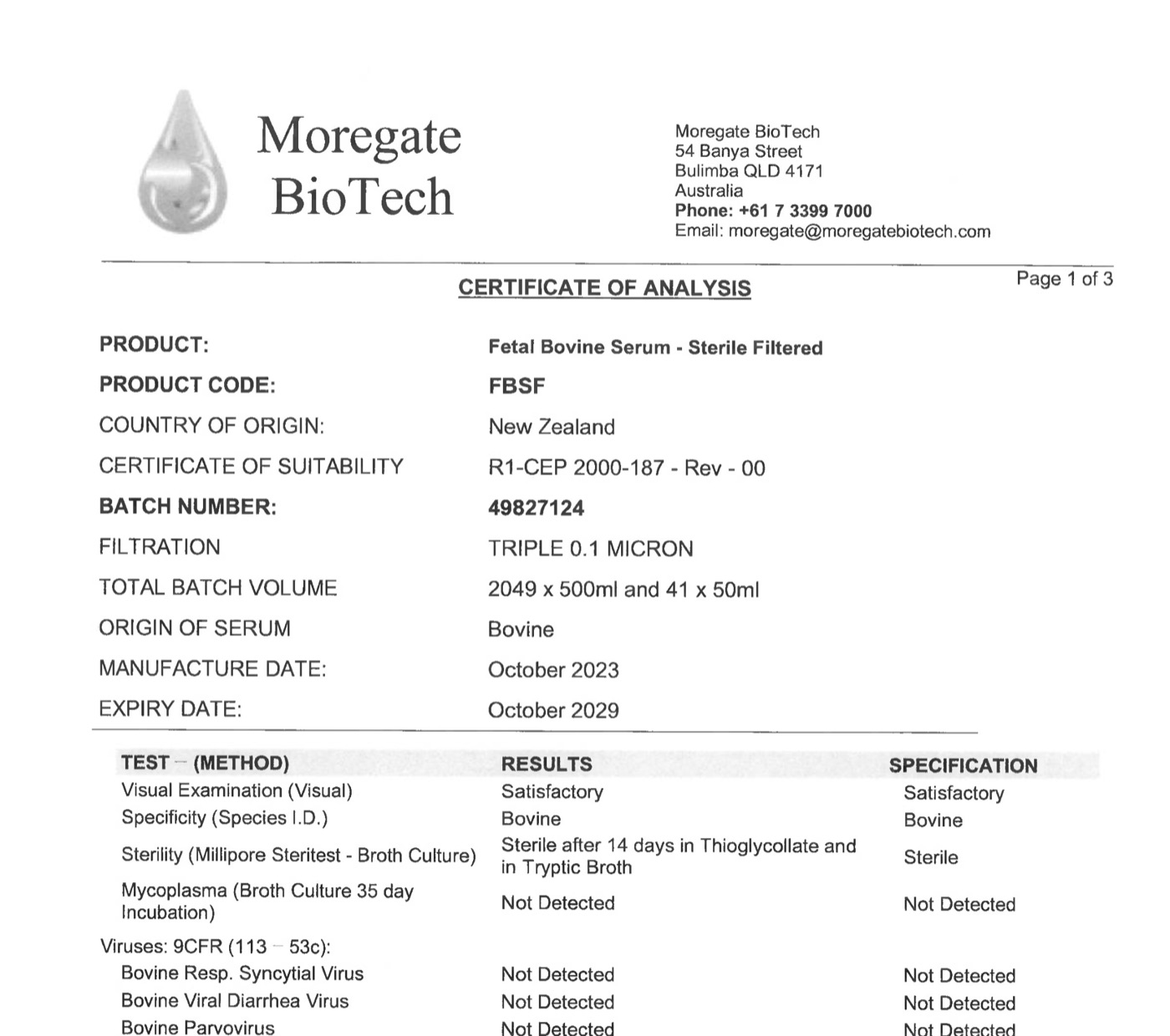
- Country of originOne named country: New Zealand.
- Certificate of SuitabilityThe EDQM CEP number, checkable online.
- Batch numberMust match your bottle label exactly.
- FiltrationTriple 0.1 µm, small enough to retain mycoplasma.
- MycoplasmaNot detected after a 35-day culture.
What does the header of an FBS CoA tell you?
The top block identifies the lot. Check that every field matches the label on your bottles before you read anything else.
| Field | This lot | What to check |
|---|---|---|
| Product / code | Fetal Bovine Serum, Sterile Filtered (FBSF) | The exact grade you ordered. Heat-inactivated, irradiated and standard serum each get their own CoA. |
| Country of origin | New Zealand | One named country. A vague region or a multi-country blend weakens traceability. |
| Certificate of Suitability | R1-CEP 2000-187 - Rev 00 | Issued by the EDQM (European Directorate for the Quality of Medicines). A TSE CEP confirms the serum meets the European Pharmacopoeia’s requirements on TSE risk. Its validity can be checked in the EDQM’s public database. |
| Batch number | 49827124 | Must match your bottle label exactly. |
| Filtration | Triple 0.1 micron | Three passes through 0.1 µm filters, a pore size small enough to retain mycoplasma. |
| Total batch volume | 2,049 × 500 mL and 41 × 50 mL (about 1,027 L) | A large single lot can supply one project for years without switching lots. |
| Manufacture / expiry | October 2023 / October 2029 | Shelf life assumes storage frozen, as the label directs. |
The footer of every page notes that Australia and New Zealand are declared free of BSE (bovine spongiform encephalopathy). That is the main reason these origins cost more, and why they are often specified for work intended for human use.
Which safety tests should an FBS CoA include?
These are pass/fail. Every result should match its specification exactly. Anything other than “Not Detected” or “Sterile” means the lot should not be in your fridge.
- Species identity: Bovine. Confirms the serum is not mixed with serum from another species.
- Sterility: sterile after 14 days in two growth broths. Thioglycollate broth catches bacteria that grow without oxygen; tryptic broth catches those that need it, plus fungi.
- Mycoplasma: not detected after 35 days of broth culture. Mycoplasma is the contaminant labs fear most because it rarely clouds the medium. The long incubation matters; a shorter test can miss slow growers.
- Viruses, tested to 9 CFR 113.53(c). This is the US federal standard for bovine-origin ingredients used in biologics. It covers nine viruses, including bovine viral diarrhoea virus (BVDV), bluetongue and rabies. All not detected.
- Viruses, tested to the EMA guideline on bovine serum. The European Medicines Agency’s guideline for serum used in making human medicines adds its own virus tests and a dedicated BVDV test. All not detected.
One line here confuses most readers: serum neutralisation assay, 102.30, “No Interference.” BVDV is common in cattle, so fetal serum can carry antibodies that neutralise the virus. Those antibodies can mask live virus during testing. This line reports how much neutralising activity the serum has, and confirms it was low enough that the BVDV test above still gives a trustworthy result.
If you work under GMP, having both the US and EU test panels on one CoA makes the serum easier to justify to your QA team and to regulators on either side.
What do antibody titres on an FBS CoA mean?
The virus tests ask whether a virus is present. The antibody tests ask a different question: does the serum contain antibodies against that virus?
This lot is negative for antibodies to BVDV (at a 1 in 4 dilution), IBR, PI3, bluetongue, Akabane and enzootic bovine leukosis (EBL).
Most cell culture work can ignore this section. It matters if you grow or test viruses, for example in vaccine production or virology. Antibodies in the serum can neutralise the very virus you are trying to grow or detect, which shows up as low yields or false negatives. If that is your work, ask for this section before you buy a lot.
How does a CoA show whether FBS is genuinely fetal?
This is the section to read most carefully. FBS is expensive, and the industry has a history of lots diluted with cheaper adult or newborn calf serum. A few numbers here make that hard to hide.
| Test | This lot | Specification | What it tells you |
|---|---|---|---|
| IgG | 55.5 mg/L | ≤ 400 mg/L | The key authenticity marker. A fetus makes almost no antibodies, so true FBS has very little IgG. Adult or calf serum has far more. |
| Gamma globulin | 1.0% | As reported | The antibody fraction on electrophoresis. Should be very low for the same reason. |
| Alpha-1 globulin | 37.0% | As reported | High in fetal serum, largely because of fetuin, a fetal protein. |
| Albumin / Beta | 53.0% / 9.0% | As reported | Together with the two above, the “typical” electrophoresis pattern. |
| Total protein | 38 mg/mL | 30–45 mg/mL | Within the normal range for FBS. |
| Haemoglobin | 0.10 mg/mL | ≤ 0.18 mg/mL | Measures red blood cells broken during collection. Lower means cleaner handling. |
| Endotoxin | < 1 IU/mL | ≤ 5 IU/mL | Bacterial toxin that can trigger immune cells and affect sensitive cultures. Lower is better. |
| Osmolality | 315 mOsmol/kg | 280–365 mOsmol/kg | Within range. Out-of-range values stress cells. |
| pH | 7.19 | 6.9–7.6 | Within range. |
Two things stand out on this lot: IgG at well under a fifth of its limit, and endotoxin below 1 IU/mL. For immune cell work, such as T cells or macrophages, endotoxin is the number to compare across suppliers.
See these numbers on the full three-page CoA for the lot we hold in India.
What does growth promotion on an FBS CoA mean?
The functional test grows four cell lines in this lot and compares their growth with the supplier’s reference (control) serum. The pass mark is 85% of the control.
| Cell line | Result (% of control) |
|---|---|
| MDBK (bovine kidney) | |
| MRC-5 (human lung fibroblast) | |
| Hybridoma | |
| Vero (monkey kidney) |
All four pass, and two grow faster than on the control serum. Read these numbers with two limits in mind:
- They are relative to the supplier’s own control, not an absolute standard, so you cannot compare percentages across suppliers.
- Your cells are not on this list. A lot that suits Vero cells can still behave differently with your stem cells or your CHO line.
This is why careful labs test a sample of a new lot on their own cells before committing, and then reserve enough of that lot for the whole project.
Why does an FBS CoA list a biochemical profile?
The last page lists 20 values from a clinical chemistry analyser: salts such as sodium (138 mmol/L) and calcium (3.42 mmol/L), glucose (7.2 mmol/L), urea, creatinine, enzymes such as LDH, and lipids. Almost all are marked “As Reported”, meaning there is no pass or fail; cholesterol is the exception, with a limit of 1.2 mmol/L (this lot: 0.6).
You will rarely act on these numbers for a single lot. Their value is in comparison. Keep the CoA for every lot you use, and when an experiment suddenly behaves differently after a lot change, this page is where you look for what moved. Labs working with lipid- or glucose-sensitive cells should compare those lines before switching lots.
What are the red flags on an FBS CoA?
Before you approve a new lot, run through these:
- The batch number on the CoA does not match the bottle label.
- No single named country of origin, or no traceability documentation behind it.
- No mycoplasma result, or a mycoplasma test far shorter than four weeks.
- Virus testing with no named standard (such as 9 CFR or the EMA guideline).
- IgG close to its limit, or no IgG figure at all. That makes dilution with adult serum impossible to rule out.
- Haemoglobin or endotoxin near the top of their range when your cells are sensitive.
- Growth promotion tested only on cell lines unrelated to yours, with no option to sample the lot.
- Mostly “As Reported” values with no specifications anywhere.
- No signatures or release dates from quality staff. This CoA carries both a scientific officer’s and a quality manager’s sign-off.
If a supplier cannot send the CoA for the exact lot you will receive before you order, treat that as a red flag too.
Frequently asked questions
What IgG level shows FBS is genuinely fetal?
A fetus makes almost no antibodies, so genuine FBS has very little IgG. The lot in this guide measured 55.5 mg/L against a limit of 400 mg/L. Adult cattle serum carries many grams per litre, so even a small amount mixed in pushes IgG up sharply.
What is an acceptable endotoxin level in FBS?
Limits vary by supplier and grade. This lot’s limit is 5 IU/mL, and it measured below 1 IU/mL. For immune cells and other sensitive cultures, compare the measured value across lots, not just the limit.
How long should mycoplasma testing take?
Culture-based tests run for weeks because mycoplasma grows slowly. This lot was cultured for 35 days. Faster PCR-based tests exist, so check which method a CoA reports.
What is a CEP on an FBS CoA?
A Certificate of Suitability (CEP) is issued by the EDQM. A TSE CEP confirms the serum meets the European Pharmacopoeia’s requirements for limiting the risk of transmissible spongiform encephalopathies. You can check whether a CEP is still valid in the EDQM certification database.
Does heat-inactivated FBS have its own CoA?
It should. Heat-inactivated serum is sold under its own product code, and heat treatment changes some values. A CoA for standard serum does not cover it.
Can I see the CoA before I buy FBS in India?
Yes. Ask for the CoA of the exact lot your distributor holds in stock in India, not a sample CoA from an older lot.
Sources
- 9 CFR Part 113, Standard Requirements (eCFR). Section 113.53 covers ingredients of animal origin, including serum.
- EMA guideline on the use of bovine serum in the manufacture of human biological medicinal products. Sections 7.3.3 and 7.3.4 cover BVDV and anti-BVDV antibody testing.
- EDQM certification database, for checking a CEP’s validity.